
January 26, 2026
Cybersecurity monitoring gives accounting firms real time visibility and protection during tax season when sensitive data volume and cyber risk are at their peak.
Share this article

Cybersecurity Monitoring is critical for accounting firms during tax season, when the volume of sensitive financial data spikes, workflows accelerate, and cybercriminal activity intensifies. As firms handle Social Security numbers, tax IDs, and banking information under tight deadlines, even a brief security lapse can lead to data exposure, operational disruption, or loss of client trust. Continuous cybersecurity monitoring provides real-time visibility into systems, users, and activity, helping firms detect suspicious behavior early, reduce dwell time, and protect both deadlines and reputations during the most demanding time of year.
Table of Contents
Hide
- 1. Why Tax Season Is a High-Risk Period for Accounting Firms
- 2. What Is Cybersecurity Monitoring in an Accounting Firm Context?
- 3. What Is Cybersecurity Monitoring in an Accounting Firm Context?
- 4. Common Cybersecurity Monitoring Gaps in Accounting Firms
- 5. Cybersecurity Monitoring vs. Reactive Security During Tax Season
- 6. How Accounting Firms Should Prepare Before and During Tax Season
- 7. Conclusion
- 8. Need Help Getting Started?
- 9. Further Reading
- 10. Related Articles
Why Tax Season Is a High-Risk Period for Accounting Firms
Tax season places accounting firms under intense operational pressure, and that pressure creates ideal conditions for cyber risk. Systems are accessed more frequently, sensitive data flows increase dramatically, and teams are often working faster than usual to meet immovable deadlines. For cybercriminals, this combination of urgency, volume, and complexity presents a prime opportunity.
Increased Volume of Sensitive Financial Data
During tax season, accounting firms process and store some of the most valuable data attackers can target. Social Security numbers, tax identification numbers, payroll records, and banking information move through firm systems at scale. This concentration of sensitive financial data significantly raises the impact of any security incident, as outlined in the IRS’s guidance on safeguarding taxpayer data. A single compromised account or exposed file can affect dozens, or even hundreds of clients at once, increasing regulatory exposure and reputational risk.
Expanded Access and Temporary Workflows
To handle seasonal demand, many firms expand access to systems and data. Temporary or seasonal staff may be onboarded quickly; remote and hybrid work becomes more common, and shared systems are accessed across longer hours. These compressed workflows often introduce gaps in visibility and oversight. When access controls, monitoring, or usage patterns are not closely observed, it becomes harder to distinguish legitimate activity from risky or malicious behavior.
Peak Targeting by Cybercriminals
Cybercriminals understand the pressures accounting firms face during tax season and actively exploit them. Phishing campaigns increase, often disguised as client communications, software updates, or urgent filing requests. Business email compromise attempts target firm leaders and finance staff, while ransomware attacks are timed to filing deadlines when downtime is least tolerable. Without continuous monitoring in place, these attacks can go unnoticed until damage has already occurred.
What Is Cybersecurity Monitoring in an Accounting Firm Context?
In an accounting firm, cybersecurity monitoring goes beyond traditional IT oversight. It focuses on maintaining continuous visibility into the systems, users, and data that support tax preparation and client services, especially during peak filing periods. Rather than relying on periodic reviews or static security tools, cybersecurity monitoring provides real time awareness of activity across the firm so potential threats can be identified and addressed before they disrupt operations or compromise sensitive information.
For accounting firms, this context matters. Tax season creates predictable spikes in data access, system usage, and external communication. Cybersecurity monitoring helps firms understand what normal activity looks like during these periods and quickly surface behavior that falls outside expected patterns.
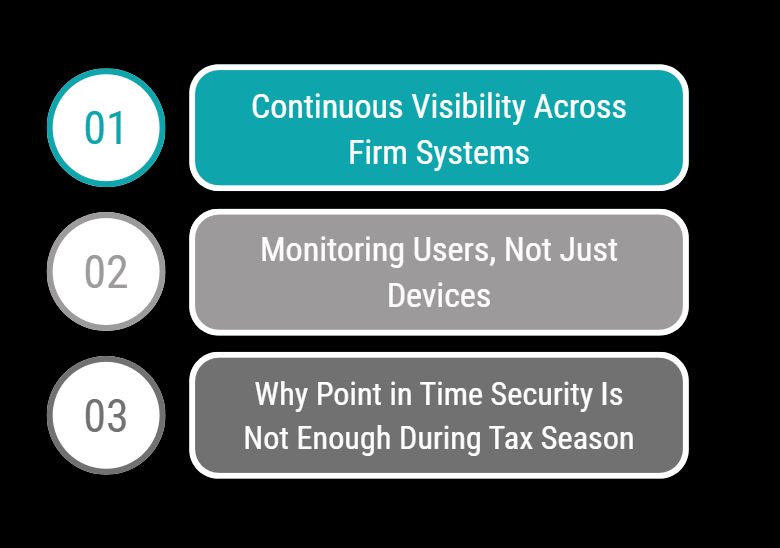
Continuous Visibility Across Firm Systems
Effective cybersecurity monitoring provides visibility across the core systems accounting firms rely on every day. This includes tax preparation software, email platforms used for client communication, and file storage or document management systems that house sensitive records. By monitoring activity across these environments, firms gain a unified view of how data is accessed, shared, and modified throughout the tax season.
This visibility is critical when multiple systems are interconnected. An email account compromise, for example, can quickly lead to unauthorized access to client files or tax documents if monitoring is not in place to identify suspicious behavior early.
Monitoring Users, Not Just Devices
While devices and systems matter, many security incidents originate from compromised user accounts. Cybersecurity monitoring in an accounting firm context places strong emphasis on user behavior, including privileged access and activity during peak hours. Monitoring login patterns, access levels, and usage timing helps firms detect anomalies that may indicate credential misuse or unauthorized access.
During tax season, extended work hours and remote access are common. Monitoring users allows firms to differentiate between legitimate late-night work and activity that warrants closer investigation.
Why Point in Time Security Is Not Enough During Tax Season
Annual risk assessments and compliance reviews play an important role, but they do not account for the rapidly changing risk landscape during tax season. Threats evolve daily, and attackers adapt their tactics to exploit periods of high pressure and limited visibility. Cybersecurity monitoring fills this gap by providing continuous insight into real time risk, allowing firms to respond as conditions change rather than after an incident has already occurred.
What Is Cybersecurity Monitoring in an Accounting Firm Context?
Cybersecurity monitoring plays a critical role in helping accounting firms stay operational and secure during tax season. When systems are under constant use and deadlines leave little room for disruption, early visibility into suspicious activity can mean the difference between a minor issue and a major incident. By continuously observing systems, users, and data movement, firms can identify risks sooner and respond before they escalate.
Early Detection of Phishing and Credential Abuse
Phishing remains one of the most common entry points for cyber incidents in accounting firms, especially during tax season. Attackers often impersonate clients, vendors, or software providers to trick staff into revealing credentials or clicking malicious links. Continuous cybersecurity monitoring, such as managed detection and response, helps identify warning signs such as unusual login locations, repeated authentication failures, or unexpected changes to email account settings.
Monitoring can also surface suspicious forwarding rules or abnormal email behavior that may indicate an account has been compromised. Detecting these indicators early allows firms to contain the issue quickly, reset access, and prevent attackers from moving deeper into firm systems.
Identifying Anomalous File Access
During tax season, large volumes of files are accessed and shared every day. Cybersecurity monitoring helps establish a baseline for normal file activity and highlights behavior that falls outside those expectations. This includes unusually large downloads, access occurring outside normal business hours, or unexpected movement of sensitive client data.
When these anomalies are detected in real time, firms can investigate promptly and determine whether the activity is legitimate or requires intervention. This level of visibility is especially important when multiple users and systems interact with the same data under tight timelines.
Reducing Dwell Time and Business Disruption
One of the most damaging aspects of a cyber incident is dwell time, which is the length of time an attacker remains undetected within an environment. The longer an incident goes unnoticed, the greater the potential impact on operations, data integrity, and client trust. Cybersecurity monitoring reduces dwell time by providing continuous insight into activity and surfacing threats as they emerge.
For accounting firms, faster detection helps prevent missed filing deadlines, extended system outages, and emergency response scenarios during the busiest time of the year. It also supports more confident decision making by giving leadership clear information when action is required.

Common Cybersecurity Monitoring Gaps in Accounting Firms
Even firms that invest in security tools often have blind spots that become more visible during tax season. These gaps are rarely intentional. They usually develop over time as firms grow, adopt new systems, or rely on assumptions about what their existing tools are doing. Cybersecurity monitoring helps uncover these weaknesses, but only if firms understand where gaps commonly occur.
Relying Solely on Antivirus or Email Filtering
ntivirus software and email filtering are important baseline controls, but they are not designed to provide full visibility into user behavior or system activity. These tools focus on blocking known threats rather than identifying suspicious patterns that may signal an emerging incident, a gap consistently highlighted in the Verizon Data Breach Investigations Report. During tax season, when phishing attempts increase and attackers use more sophisticated tactics, relying only on these controls leaves firms vulnerable to threats that slip past automated defenses.
Without cybersecurity monitoring in place, firms may not realize an account has been compromised until unusual behavior escalates into a larger issue.
No Twenty-Four Seven Monitoring Coverage
Many accounting firms only have security oversight during standard business hours. Tax season rarely follows a standard schedule. Staff often work evenings and weekends, and systems remain active around the clock. This creates extended windows where suspicious activity can occur without being noticed.
Lack of continuous monitoring means alerts may go unseen for hours or days, increasing dwell time and potential impact. Cybersecurity monitoring ensures visibility is maintained even when internal teams are unavailable or focused on client deadlines.
Alerts Without Clear Ownership or Response
Security alerts are only useful if someone is responsible for reviewing and responding to them. In many firms, alerts are generated but not clearly assigned, documented, or acted upon. This leads to delays, confusion, or ignored warnings during busy periods.
Effective cybersecurity monitoring includes defined processes for triage, escalation, and response, so alerts translate into timely action rather than added noise.
Assuming Compliance Equals Security
Accounting firms often operate under regulatory or professional compliance requirements, which can create a false sense of security. Compliance frameworks define minimum standards, but they do not guarantee real time threat detection or protection against evolving attacks.
Cybersecurity monitoring complements compliance by providing ongoing insight into how systems and users behave day to day. This visibility helps firms move beyond checkbox security and focus on reducing actual risk during tax season.
Cybersecurity Monitoring vs. Reactive Security During Tax Season
During tax season, the difference between proactive cybersecurity monitoring and reactive security approaches becomes especially clear. Reactive security relies on responding after a problem has already occurred. Cybersecurity monitoring focuses on identifying warning signs early, so action can be taken before operations, data, or client relationships are impacted.
Responding After a Breach vs. Preventing One
Reactive security assumes incidents will be discovered through obvious failures such as system outages, client complaints, or confirmed data exposure. By the time these signals appear, meaningful damage has often already occurred. Recovery efforts during tax season can be especially disruptive, pulling attention away from client work and critical deadlines.
Cybersecurity monitoring shifts the focus to prevention by continuously observing activity and flagging suspicious behavior as it happens. This allows firms to investigate and contain issues early, often before an incident escalates into a breach.
The Cost of Downtime During Filing Deadlines
Downtime during tax season carries a higher cost than at any other time of year. Even short disruptions can delay filings, create backlogs, and erode client confidence. Reactive security approaches increase the likelihood of extended downtime because incidents are detected later and require more extensive remediation.
With cybersecurity monitoring in place, firms are better positioned to minimize disruption. Early detection supports faster decision making and targeted response, reducing the risk of prolonged outages when time is most critical.
Why Visibility Matters More Than Tools
Many accounting firms invest in security tools but lack clear visibility into how those tools are performing or what is happening across their environment. Tools alone do not provide context. Without continuous monitoring, it is difficult to distinguish normal seasonal activity from genuine risk.
Cybersecurity monitoring provides the visibility needed to make informed decisions. It connects activity across systems and users, giving firms insight into where attention is required and helping leadership move from reactive firefighting to confident risk management during tax season.
How Accounting Firms Should Prepare Before and During Tax Season
Preparation is one of the most effective ways accounting firms can reduce cyber risk during tax season. Cybersecurity monitoring is most effective when it is established before peak workloads begin and supported by clear processes throughout the filing period. Firms that prepare early are better positioned to respond calmly and decisively when issues arise.
Establishing Continuous Monitoring Before Peak Periods
Cybersecurity monitoring should be in place well before tax season starts. Waiting until systems are under heavy use limits the ability to establish a clear baseline of normal activity. As explained in our Insight on IT security risk management and why it matters for your business, implementing monitoring early allows firms to identify risks, understand typical access patterns, and assess system behavior before seasonal changes increase complexity and exposure.
This preparation allows firms to identify abnormal behavior more accurately during tax season and reduces the likelihood of false alarms or missed indicators when activity naturally increases.
Aligning Monitoring With Incident Response
Monitoring alone is not enough if there is no clear plan for how alerts will be handled. Accounting firms should align cybersecurity monitoring with defined incident response procedures so that potential issues are evaluated quickly and consistently. This includes knowing who reviews alerts, how decisions are made, and when escalation is required.
During tax season, clarity matters. When everyone understands their role, firms can respond efficiently without disrupting client service or internal workflows.
Knowing When to Escalate and Act
Not every alert requires immediate action, but some demand prompt attention. Cybersecurity monitoring helps firms identify which signals indicate real risk and which represent routine activity. Establishing escalation criteria in advance helps firms avoid hesitation or overreaction during busy periods.
Clear thresholds for action support confident decision making and reduce uncertainty for leadership and staff. This readiness allows firms to focus on delivering client work while maintaining strong security posture throughout tax season.
Conclusion
Cybersecurity monitoring plays a critical role in helping accounting firms navigate the heightened risk that comes with tax season. As sensitive data volumes increase, access expands, and deadlines tighten, firms need more than basic security tools to stay protected. Continuous visibility into systems, users, and activity allows firms to detect issues early, reduce disruption, and maintain confidence during their busiest period of the year.
By investing in cybersecurity monitoring, accounting firms protect more than technology. They protect client trust, operational continuity, and professional reputation. Monitoring supports faster decision making, clearer accountability, and stronger resilience when pressure is highest.
For firms preparing for an upcoming tax season or reassessing their current security posture, now is the time to act. Proactive evaluation before peak workloads begin allows firms to identify gaps, establish monitoring baselines, and align response processes in advance. Whether through an internal review, a readiness assessment, or managed monitoring services, taking the next step before tax season hits can make a meaningful difference when it matters most.
If your firm is preparing for the upcoming tax season or reassessing its current security posture, now is the time to take the next step. A proactive review before peak workloads begin can help identify gaps, establish effective monitoring baselines, and ensure response processes are in place when they are needed most.
Contact thirtyone3 technology to schedule a cybersecurity readiness conversation and learn how proactive monitoring can help protect your firm, your clients, and your reputation during tax season and beyond.
Need Help Getting Started?
Your IT should empower your business, not hold it back. Partner with thirtyone3 technology to get the clarity, security, and results you deserve. Let's start a conversation today.
Contact us
Further Reading
-
IT Security Risk Management and Why It Matters for Your Business
An overview of how structured risk management helps organizations move from reactive security to proactive prevention, including the role of ongoing monitoring and assessment. -
Managed IT & Security Services to Protect, Support, and Grow Your Business
An overview of how proactive IT management, continuous monitoring, and security services help organizations detect issues early, reduce operational risk, and maintain stability during peak business periods.
-
IRS Publication 4557: Safeguarding Taxpayer Data
Official IRS guidance for tax professionals on protecting sensitive taxpayer information and meeting security expectations. -
Verizon Data Breach Investigations Report (DBIR)
Annual industry analysis detailing common attack vectors, including phishing and credential misuse, and why many breaches bypass traditional security controls.