
January 16, 2026
Help desk strain builds quietly through inconsistent response times, staffing pressure, and rising security demands. This insight outlines six signs it’s time for outsourced help desk support and what to evaluate next.
Share this article

Outsourced Help Desk Support becomes a strategic necessity when internal IT teams are overwhelmed by reactive work, inconsistent response times, staffing challenges, and increasing security and compliance demands. While many organizations delay this decision in hopes of stabilizing internally, the warning signs often surface quietly through declining user experience, stalled initiatives, and growing operational risk.
This insight outlines six clear indicators that your current support model may no longer be sustainable. From ticket overload and burnout driven turnover to environments that grow more complex faster than support processes can scale, each sign reflects a common inflection point for mid sized and growing organizations. Left unaddressed, these challenges can erode productivity, frustrate employees, and expose the business to security and compliance gaps.
By recognizing these signals early, leadership teams can take a proactive approach to stabilizing IT operations. We also explore what to look for when evaluating outsourced help desk providers, including governance, visibility, industry experience, and tool integration. Ultimately, the goal is not to relinquish control. It is to create consistency, reduce risk, and allow internal IT teams to refocus on strategic, high value work that supports long term business growth.
Table of Contents
Hide
- 1. Why Outsourced Help Desk Support Is a Decision Many Organizations Delay Too Long
- 2. Sign 1: Your Internal IT Team Is Constantly in Reactive Mode
- 3. Sign 2: Response Times Are Inconsistent and Hard to Measure
- 4. Sign 3: You Are Struggling to Staff or Retain Help Desk Talent
- 5. Sign 4: User Experience Is Becoming a Business Issue
- 6. Sign 5: Growth and Change Are Outpacing Your Support Model
- 7. Sign 6: Security and Compliance Are Competing With Daily Support Needs
- 8. What to Look for When Evaluating Outsourced Help Desk Support
- 9. Final Thoughts on Outsourced Help Desk Support
- 10. Need Help Getting Started?
- 11. Further Reading
- 12. Related Articles
Why Outsourced Help Desk Support Is a Decision Many Organizations Delay Too Long
Most organizations do not decide to outsource their help desk because of a single failure or crisis. The decision typically comes after a prolonged period of operational strain, when small manageable issues accumulate into persistent friction that impacts the entire business.
Help Desk Challenges Tend to Build Quietly Over Time
Help desk issues rarely arrive with alarms. Instead, response times extend slightly each quarter. Backlogs become more common during peak periods. Internal IT teams begin to treat constant interruption as normal. Over time, these conditions become institutionalized, even as service quality and employee satisfaction decline.
Because nothing appears broken, leadership may assume the model is still working despite growing signals that it is no longer keeping pace with business demands.
The Hidden Cost of Waiting Too Long
The cost of delay is not always obvious on a balance sheet. Productivity suffers when employees wait for support or create workarounds. Security risk increases as maintenance tasks are postponed. IT teams spend more time responding and less time improving.
Eventually, the organization reaches a point where change feels urgent rather than strategic, often resulting in rushed decisions instead of planned transitions.
For additional perspective on how these patterns show up across industries, explore our technology and security insights.
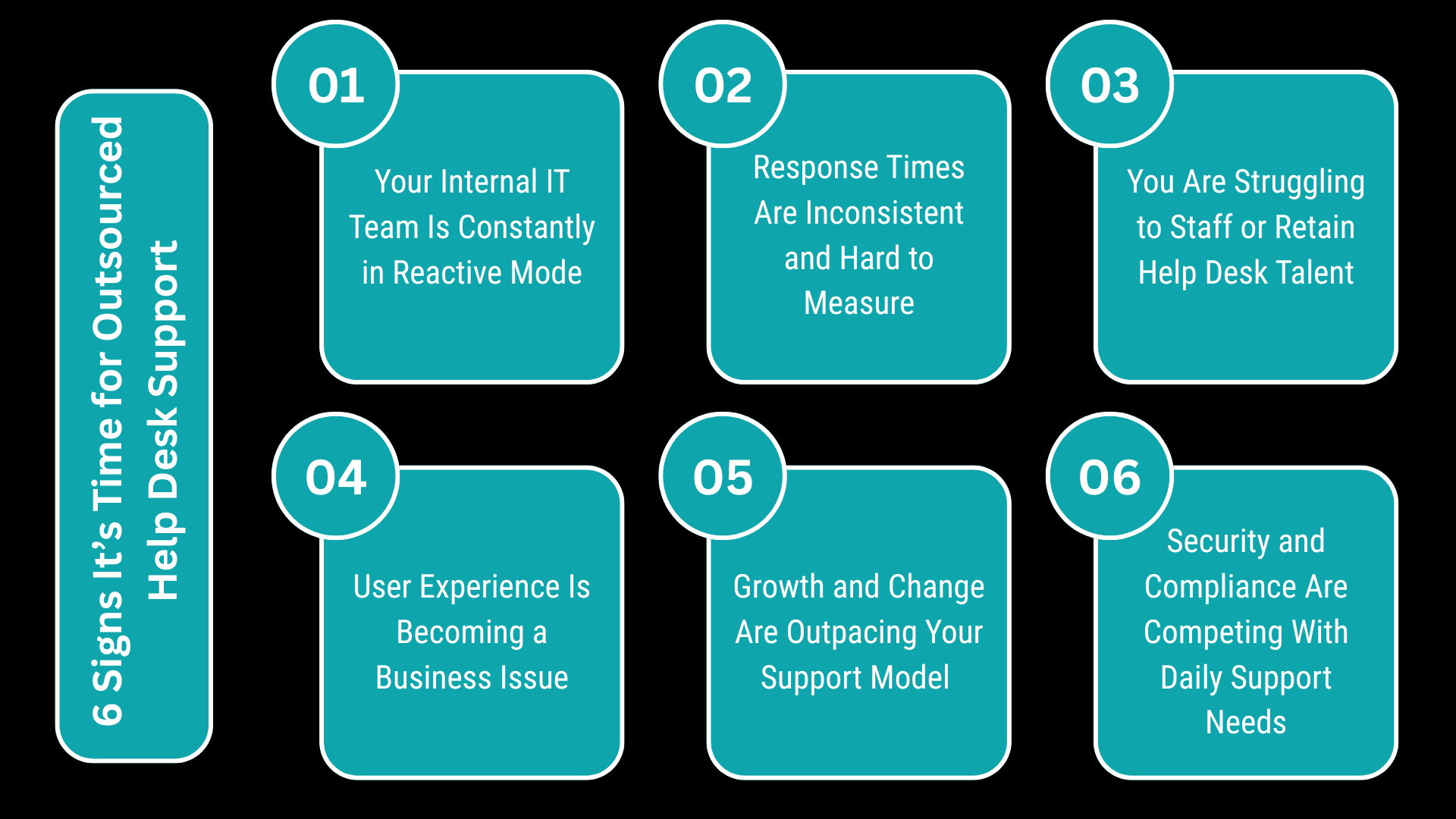
Sign 1: Your Internal IT Team Is Constantly in Reactive Mode
Tickets Are Consuming the Workday
When ticket volume dominates the workday, IT teams lose the ability to prioritize effectively. Urgent requests displace important ones, and long-term improvements are consistently delayed in favor of immediate fixes.
This reactive posture limits the team’s ability to prevent recurring issues, optimize systems, or introduce efficiencies that would reduce ticket volume in the first place.
Strategic IT Work Keeps Getting Pushed Aside
Security initiatives, lifecycle planning, documentation, and process improvement all suffer when reaction becomes the default mode. Over time, IT shifts from being a strategic enabler to a bottleneck. Many organizations begin exploring managed IT services to regain balance between day-to-day operations and long-term goals.
Sign 2: Response Times Are Inconsistent and Hard to Measure
Users Do Not Know What to Expect From IT
Inconsistent response times create uncertainty. Employees do not know whether an issue will be resolved quickly or linger for days. This unpredictability erodes trust in IT and encourages shadow IT, informal workarounds, and repeated follow ups.
Over time, even small delays compound into measurable productivity loss across teams.
Leadership Lacks Visibility Into Support Performance
Without standardized service level agreements, reporting, and trend analysis, leadership has limited insight into support effectiveness. It becomes difficult to identify patterns, justify investments, or measure improvement. In many cases, the absence of data masks the true scale of the problem until dissatisfaction becomes widespread.

Sign 3: You Are Struggling to Staff or Retain Help Desk Talent
Hiring Help Desk Talent Is Slow and Expensive
The market for qualified help desk professionals remains highly competitive. Recruiting cycles are longer, candidate pools are smaller, and onboarding takes time before new hires become fully productive.
These delays place additional strain on existing staff, increasing the likelihood of burnout before relief arrives.
Burnout and Turnover Create Instability
High ticket volume, constant urgency, and limited advancement opportunities contribute to burnout. When turnover follows, institutional knowledge disappears, documentation gaps widen, and users experience inconsistent support.
According to industry research from Gartner on IT talent shortages and managed services adoption, many organizations turn to outsourced support models to stabilize service delivery and reduce staffing pressure.
Sign 4: User Experience Is Becoming a Business Issue
IT Support Complaints Are Escalating Beyond IT
When support issues routinely reach managers and executives, IT support stops being an operational concern and becomes a leadership issue. Escalations signal that service gaps are impacting workflows, deadlines, and customer facing outcomes.
At this stage, leadership attention is no longer optional. It is required.
Poor Support Is Impacting Productivity and Morale
Employees who cannot get timely support lose momentum. Repeated disruptions reduce morale and increase frustration, particularly in hybrid or remote environments where IT support is critical to daily work.
Sign 5: Growth and Change Are Outpacing Your Support Model
Your Environment Is Becoming More Complex
As organizations grow, so does technical complexity. New applications, devices, integrations, and access requirements all increase support demand. What worked for a smaller environment quickly becomes unsustainable without additional structure and coverage.
Existing Processes Do Not Scale With the Business
Manual workflows, inconsistent onboarding, and ad hoc offboarding introduce inefficiency and risk. These challenges are especially common in fast-evolving and regulated industries.
Organizations in professional and technical services environments often experience this strain first
Similar issues arise within health care and social assistance organizations And they are especially pronounced in finance and insurance organizations where compliance requirements add complexity. Without scalable support processes, growth amplifies existing weaknesses rather than strengthening operations.
Sign 6: Security and Compliance Are Competing With Daily Support Needs
Security Tasks Are Regularly Deprioritized
When ticket queues dominate attention, security work often takes a back seat. Patching schedules slip. Access reviews are delayed. Monitoring and alert tuning fall behind. Over time, these small gaps create significant exposure.
Audit Readiness and Documentation Are Slipping
Incomplete documentation and last minute audit preparation increase stress and compliance risk. NIST risk management and governance frameworks reinforce the importance of repeatable controls, documentation, and accountability.
What to Look for When Evaluating Outsourced Help Desk Support
Industry Experience and Onboarding Approach
Effective providers understand how your business operates, not just how your technology works. Industry familiarity shortens onboarding timelines, reduces friction, and improves first contact resolution.
A strong onboarding process should include documentation review, escalation mapping, and clear success metrics for the first ninety days.
Governance, Escalation, and Accountability
Clear ownership, documented escalation paths, and transparent reporting are essential. Outsourcing should improve accountability, not obscure it. When governance is done well, leadership gains better visibility than many internal models provide.
Tool Integration and Visibility
The right partner integrates with existing tools and workflows, preserving visibility and control while improving consistency. This ensures outsourced support enhances operations without creating blind spots.

Final Thoughts on Outsourced Help Desk Support
Outsourced Help Desk Support is not about losing control. It is about restoring stability, consistency, and focus. For many organizations, it creates the capacity internal IT teams need to shift from constant reaction to proactive, strategic work that drives the business forward.
When support operations align with business growth, user expectations, and security priorities, IT becomes a driver of progress rather than a constraint. Recognizing the signs early allows organizations to make thoughtful, strategic decisions before support challenges begin to limit what the business can achieve.
If you are starting to see these signs in your own environment and want to understand whether outsourced help desk support is the right next step, contact us to start the conversation. We can help you evaluate your current support model, identify gaps, and determine an approach that improves consistency while keeping you in control.
Need Help Getting Started?
Your IT should empower your business, not hold it back. Partner with thirtyone3 technology to get the clarity, security, and results you deserve. Let's start a conversation today.
Contact us
Further Reading
-
Related Insights and Resources
Explore additional perspectives on IT operations, support models, security, and leadership challenges.
Technology and Security Insights:
https://thirtyone3technology.com/resources/blog/ -
Managed IT and Support Services:
Learn more about service models designed to improve consistency, visibility, and operational resilience.
Managed IT Services:
https://thirtyone3technology.com/managed-it-and-security-services/managed-it-services/IT Security Services:
https://thirtyone3technology.com/managed-it-and-security-services/it-security-services/IT Compliance and Audit Readiness:
https://thirtyone3technology.com/managed-it-and-security-services/it-compliance-services-audit-readiness/ -
Industry Specific IT Services
See how scalable support models apply across regulated and fast growing industries.
Professional, Scientific, and Technical Services:
https://thirtyone3technology.com/managed-it-services-by-industry/professional-scientific-technical-services/Health Care and Social Assistance:
https://thirtyone3technology.com/managed-it-services-by-industry/health-care-social-assistance/Finance and Insurance:
https://thirtyone3technology.com/managed-it-services-by-industry/finance-insurance/ -
External References
Authoritative guidance and research that informed this insight.
Gartner Research on IT Talent Shortages and Managed Services:
Gartner Identifies Four Trends Talent Management Leaders Should Prepare for in 2026CISA Operational Resilience and Incident Response Guidance:
Cybersecurity Incident Response | CISANIST Risk Management and Cybersecurity Frameworks:
Cybersecurity Framework | NIST