
June 19, 2024
Unlock flexible, secure infrastructure that blends private and public cloud and on-premises systems. Learn how hybrid cloud boosts agility, lowers costs, strengthens disaster recovery and the strategies to conquer its challenges.
Share this article

In today’s rapidly evolving digital landscape, businesses are continuously seeking innovative ways to enhance their information technology (IT) infrastructure. One such groundbreaking solution is the hybrid cloud, a model that seamlessly integrates private and public cloud services with on-premises infrastructure.
This approach offers a harmonious blend of flexibility, scalability, and security, making it a preferred choice for organizations aiming to optimize their IT operations.
The hybrid cloud’s significance lies in its ability to cater to diverse business needs, providing the best of both worlds: the control and security of a private cloud and the agility and cost-efficiency of a public cloud.
As companies navigate the complexities of digital transformation, understanding hybrid cloud capabilities, benefits, and challenges becomes crucial for making informed strategic decisions.
Let’s dig into the components, capabilities, and the advantages hybrid cloud offers. We will also address the challenges associated with adoption and present strategies to overcome them.
What is a Hybrid Cloud?
A hybrid cloud is an IT architecture that combines the best features of private and public clouds along with on-premises infrastructure. This model allows data and applications to be shared between them, offering businesses the flexibility to optimize their resources based on specific needs and workloads.
Components of a Hybrid Cloud
- Private Cloud: This is a cloud environment dedicated to a single organization, providing enhanced security and control. It is ideal for sensitive data and critical applications that require stringent compliance and governance.
- Public Cloud: In contrast, public cloud services are provided by third-party vendors over the internet. They offer scalable resources on a pay-as-you-go basis, making them cost-effective for handling variable workloads and less sensitive data.
- On-Premises Infrastructure: Traditional IT infrastructure that resides within an organization’s physical premises. It offers full control over hardware and software but lacks the scalability and flexibility of cloud solutions.
Integration and Interoperability
Hybrid cloud seamlessly integrates these components, allowing data and applications to move freely between private and public clouds and on-premises systems.
This interoperability ensures that organizations can leverage the strengths of each environment to meet their specific business requirements. For instance, an organization might use a private cloud for sensitive customer data while utilizing the public cloud for large-scale data analytics.
Use Cases:
- Data Sensitivity: Companies with sensitive data might keep critical information on private clouds or on-premises while using public clouds for less sensitive operations.
- Scalability Needs: Organizations experiencing fluctuating demand can benefit from the scalability of public clouds without overcommitting to infrastructure investments.
- Disaster Recovery: Hybrid cloud models enhance disaster recovery strategies by providing a reliable backup and recovery solution across multiple environments.
By understanding what this model is and how it integrates various IT environments, businesses can strategically position themselves to leverage its full potential.
What is a Hybrid Cloud?
The capabilities are the foundation of its appeal, offering a versatile and robust IT solution for modern businesses. By combining the strengths of private and public clouds along with on-premises infrastructure, hybrid cloud delivers a range of capabilities that enhance operational efficiency and strategic agility.
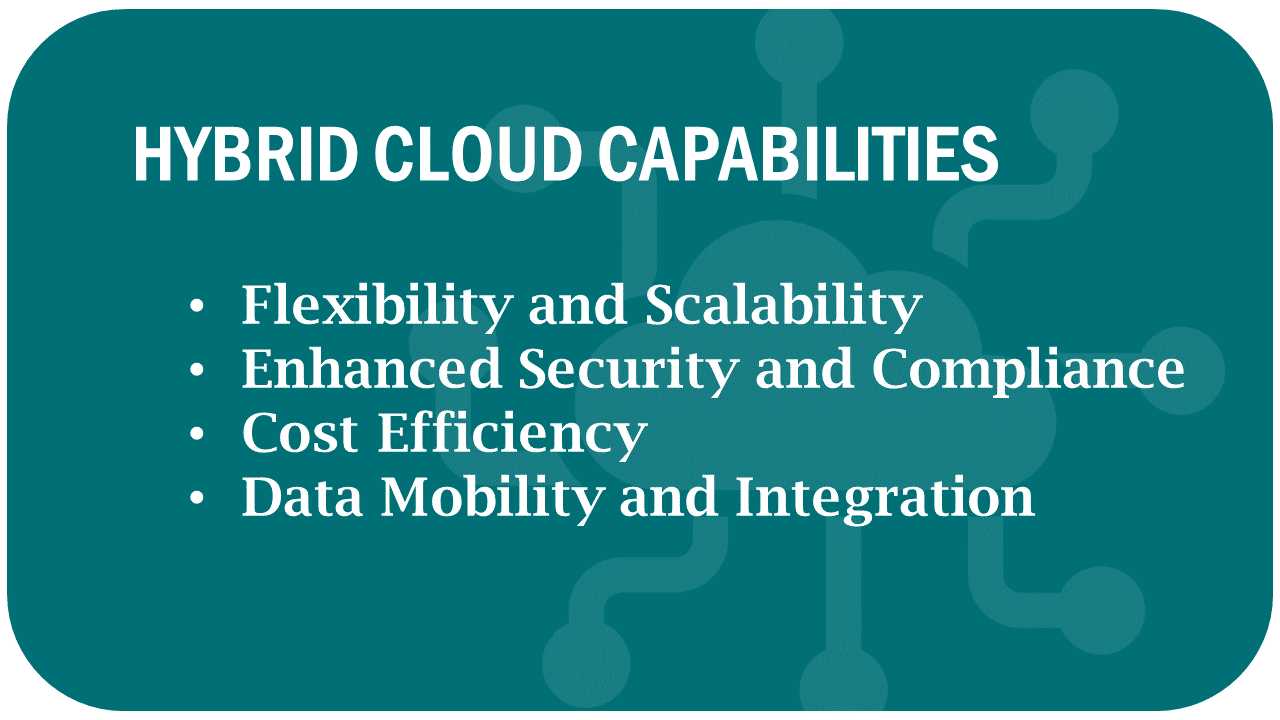
Flexibility and Scalability
One of the primary capabilities is its unmatched flexibility and scalability. Businesses can dynamically scale their resources up or down based on demand, ensuring they only pay for what they use. This elasticity allows companies to handle sudden spikes in workload without overinvesting in infrastructure, optimizing both performance and cost-efficiency.
Enhanced Security and Compliance
Hybrid cloud provides enhanced security measures by allowing sensitive data to remain within private clouds or on-premises environments, where stringent security and compliance protocols can be enforced.
At the same time, less sensitive data and applications can be deployed in public clouds. This dual approach ensures that businesses can meet specific regulatory requirements and maintain control over critical information.
Cost Efficiency
Cost efficiency is another significant capability of hybrid cloud. By leveraging public cloud services for non-sensitive operations and utilizing private clouds or on-premises infrastructure for critical tasks, businesses can optimize their IT spending. This hybrid approach balances the need for high performance and security with the benefits of cost-effective scalability provided by public cloud services.
Data Mobility and Integration
Hybrid cloud facilitates seamless data mobility and integration, allowing data and applications to move freely across different environments. This capability ensures that businesses can easily adapt to changing requirements, integrating modern technologies and processes without disrupting existing operations. The interoperability of hybrid cloud environments supports continuous innovation and agile responses to market changes.
By harnessing these capabilities, businesses can achieve a more responsive, secure, and cost-effective IT infrastructure. The flexibility, enhanced security, cost efficiency, and seamless data integration offered by hybrid cloud make it a powerful tool for driving digital transformation and achieving strategic goals.
Benefits of a Hybrid Cloud
Adopting a hybrid cloud model offers numerous benefits that can significantly enhance an organization’s IT operations and overall business strategy. By combining the strengths of private and public clouds, businesses can achieve a level of agility, efficiency, and resilience that is difficult to attain with a single cloud solution.
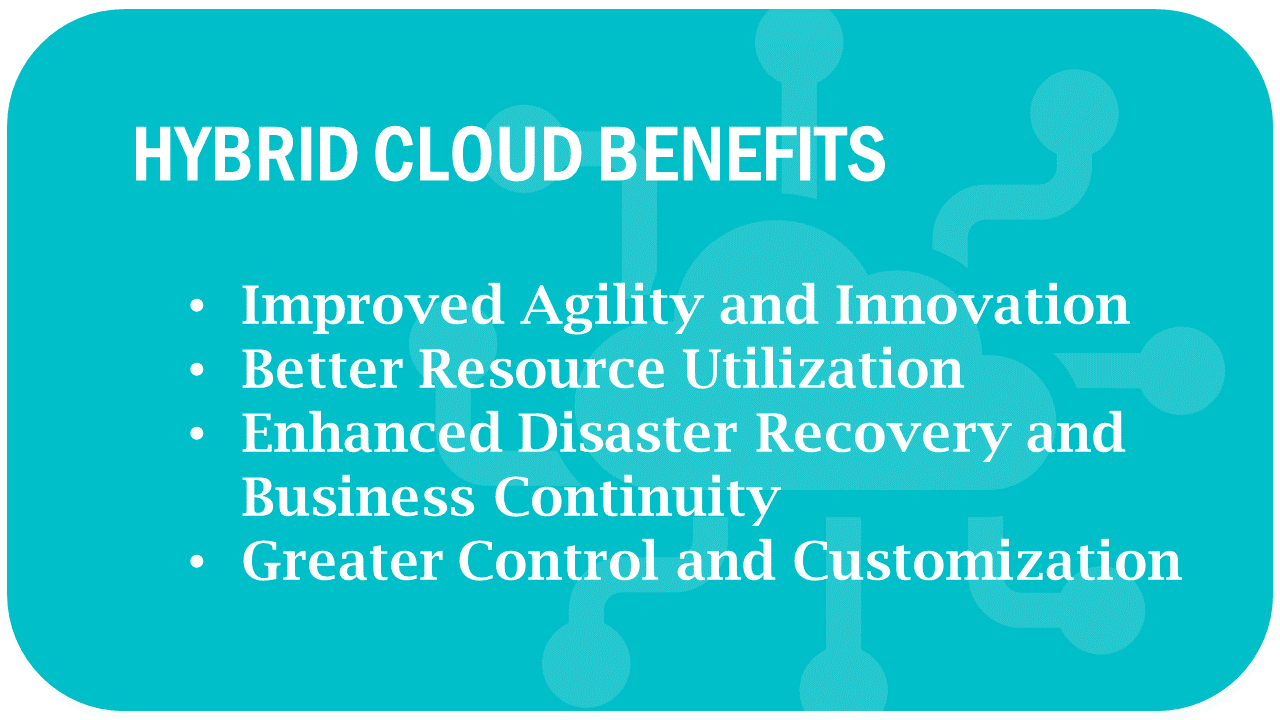
Improved Agility and Innovation
One of the most compelling benefits of a hybrid cloud is the increased agility it provides. Businesses can quickly deploy and scale applications, responding swiftly to market demands and customer needs.
This rapid adaptability fosters innovation, allowing companies to experiment with innovative technologies and services without the constraints of traditional IT infrastructure. By leveraging hybrid cloud, organizations can stay ahead of the competition by bringing new products and features to market faster.
Better Resource Utilization
Hybrid cloud enables optimal resource utilization by allowing businesses to allocate workloads to the most appropriate environment. Critical applications and sensitive data can be managed within private clouds or on-premises systems, ensuring high security and compliance.
Simultaneously, less critical workloads can be offloaded to public clouds, where resources can be scaled up or down as needed. This strategic distribution of resources maximizes efficiency and minimizes waste, resulting in cost savings and improved performance.
Enhanced Disaster Recovery and Business Continuity
Hybrid cloud significantly enhances disaster recovery and business continuity capabilities. By distributing data and applications across multiple environments, businesses can ensure redundancy and resilience.
In the event of a failure in one environment, operations can continue seamlessly in another, minimizing downtime and maintaining service availability. This robust disaster recovery strategy is crucial for protecting business operations and maintaining customer trust.
Greater Control and Customization
This model offers greater control and customization compared to traditional cloud solutions. Businesses can tailor their cloud environment to meet specific needs, selecting the right mix of public and private cloud resources.
This customization extends to security policies, compliance requirements, and performance optimization, allowing organizations to create a cloud strategy that aligns perfectly with their unique objectives and constraints. By leveraging the benefits of a hybrid cloud, businesses can achieve a more agile, efficient, and resilient IT infrastructure.
The improved agility, better resource utilization, enhanced disaster recovery, and greater control offered by hybrid cloud make it an invaluable asset for modern organizations striving to stay competitive and innovative in a rapidly changing digital landscape.
Challenges of a Hybrid Cloud
While the hybrid cloud offers numerous advantages, it also presents certain challenges that organizations must address to fully reap its benefits. Understanding these challenges is crucial for developing effective strategies to overcome them and ensure a smooth hybrid cloud implementation.
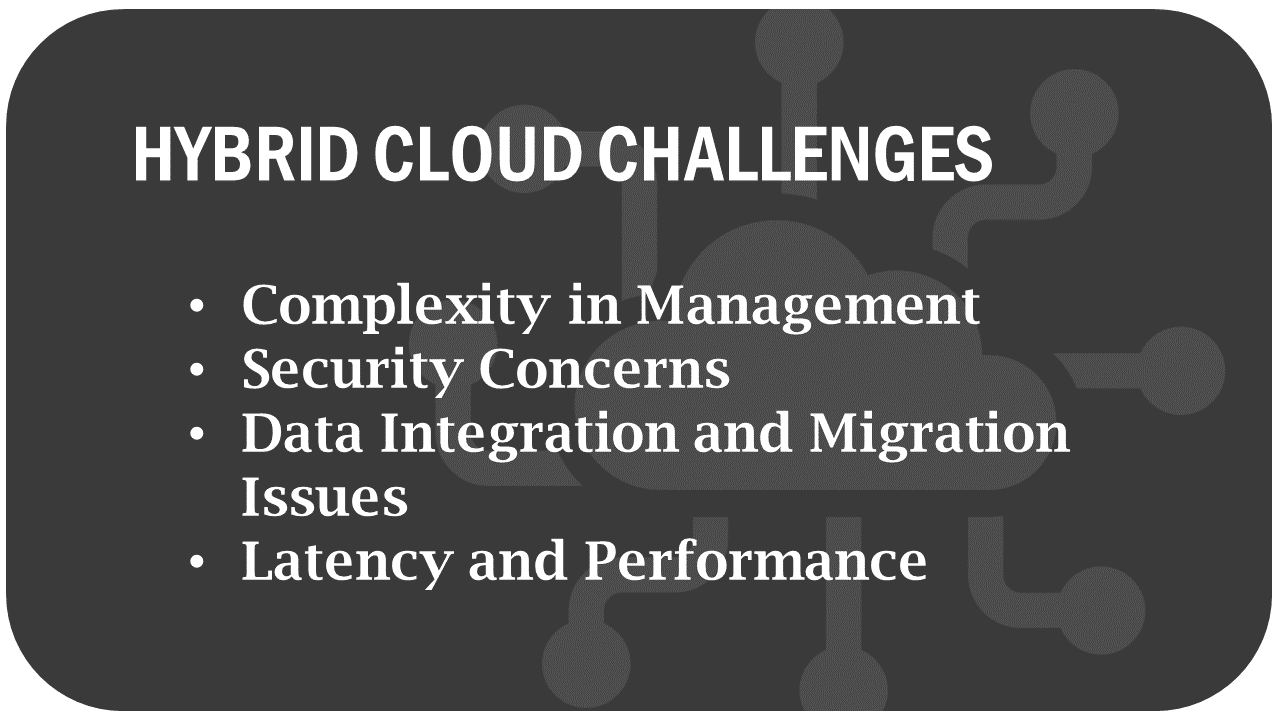
Complexity in Management
Managing this type of environment can be significantly more complex than managing a single cloud solution. The integration of private, public, and on-premises infrastructure requires robust management tools and processes to ensure seamless operation.
IT teams must be proficient in managing diverse environments and coordinating between them to avoid silos and inefficiencies. This complexity often demands advanced skills and comprehensive training, which can increase operational overhead.
Security Concerns
While hybrid cloud offers enhanced security capabilities, it also introduces new security challenges. Ensuring consistent security policies across multiple environments can be difficult, leading to potential vulnerabilities. Organizations must implement rigorous security measures, such as encryption, access controls, and continuous monitoring, to protect data and applications.
Additionally, compliance with industry regulations can be more challenging when data is spread across different cloud environments.
Data Integration and Migration Issues
Data integration and migration are critical aspects of hybrid cloud deployment, and they come with their own set of challenges. Moving data between private and public clouds or on-premises systems can be complex and time-consuming.
Organizations must ensure data consistency and integrity during these processes, which often require sophisticated data management tools. Furthermore, latency issues and data transfer costs can arise, impacting overall performance and budget.
Latency and Performance
Hybrid cloud environments can sometimes suffer from latency and performance issues due to the distributed nature of the infrastructure. Data and applications that need to communicate across different environments may experience delays, affecting user experience and operational efficiency.
Ensuring optimal performance requires careful planning and the implementation of solutions such as optimized network configurations and efficient data routing.
Addressing these challenges is essential for organizations to fully leverage the potential of hybrid cloud. By recognizing the complexities in management, addressing security concerns, streamlining data integration and migration, and mitigating latency and performance issues, businesses can create a robust and effective hybrid cloud strategy.
Strategies for Overcoming Hybrid Cloud Challenges
Successfully navigating the complexities of a hybrid cloud environment requires strategic planning and the implementation of robust solutions. Here are some effective strategies to address the challenges discussed previously, ensuring a smooth and efficient hybrid cloud deployment.
Implementing Unified Management Tools
To handle the complexity of managing multiple environments, organizations should invest in unified management tools. These tools provide a centralized platform for monitoring, managing, and optimizing hybrid cloud resources.
Solutions like cloud management platforms (CMPs) and integrated management suites can help streamline operations, offering visibility across all environments and ensuring consistent policies and procedures. By automating routine tasks and centralizing control, these tools reduce the administrative burden on IT teams.
Strengthening Security Measures
Addressing security concerns in a hybrid cloud requires a multi-layered approach. Organizations should implement robust security frameworks that encompass encryption, identity, and access management (IAM), and continuous monitoring.
Establishing consistent security policies across all environments is crucial to prevent vulnerabilities. Additionally, leveraging advanced security technologies such as zero-trust architecture and automated threat detection can enhance protection. Regular security audits and compliance checks ensure that security measures remain effective and up to date.
Streamlining Data Migration Processes
Efficient data integration and migration are vital for hybrid cloud success. Organizations should utilize specialized data management tools that facilitate seamless data transfer and integration across environments. Implementing data synchronization and replication solutions can ensure data consistency and availability.
To minimize latency and data transfer costs, businesses should plan data migration carefully, considering factors like bandwidth, transfer schedules, and the use of edge computing for data processing closer to the source.
Optimizing Network Performance
Mitigating latency and performance issues in a hybrid cloud environment requires optimizing network configurations. Organizations should implement strategies such as deploying content delivery networks (CDNs) and using direct connections like AWS Direct Connect or Azure ExpressRoute to enhance data transfer speeds.
Additionally, employing advanced network monitoring and management tools can help identify and resolve performance bottlenecks. Ensuring that network infrastructure is robust and scalable supports the smooth operation of hybrid cloud applications.
By implementing these strategies, businesses can effectively address the challenges of hybrid cloud deployment. Unified management tools, strengthened security measures, streamlined data migration processes, and optimized network performance are key to unlocking the full potential of hybrid cloud, driving operational efficiency and strategic agility.
Need Help Getting Started?
Your IT should empower your business, not hold it back. Partner with thirtyone3 technology to get the clarity, security, and results you deserve. Let's start a conversation today.
Contact us